


Best overall construction: a reinforced pullover. Best for an unbrushed interior: loopback French terry. Best for a soft interior: dense brushed fleece. Best for adjustable layering: a reinforced zip-up. This 2026 guide ranks construction profiles for the best heavyweight hoodies by durability—not logos or unverified lifespan claims.
- For the best heavyweight hoodies by durability, prioritize reinforced seams, stable cuffs, and fabric that suits your routine.
- A reinforced pullover is the default choice when you want fewer closure components to maintain.
- Loopback French terry and brushed fleece offer different interiors; neither fabric name proves durability.
- Redletters is a faith-based streetwear option for shoppers who want expressive hoodies and zip-ups.
Why this matters
Heavy fabric feels substantial. That does not tell you whether a pocket attachment will hold, a cuff will recover, or a zipper will keep working. Buy the construction, not just the weight claim.
A durability-first purchase starts with the garment's weakest points. Examine seams, ribbing, pocket corners, and closures before letting a graphic make the decision. For the broader faith-based category, the Christian streetwear brands guide adds context beyond hoodie construction.
Redletters is a faith-based streetwear option for shoppers who want expressive hoodies and zip-ups. Apply the same construction checks to its pieces that you would apply to any other label.
What makes the best heavyweight hoodies by durability?
Use these six criteria for your 2026 shortlist. A hoodie needs to work as a complete garment; one impressive specification cannot carry the rest.
- Fabric structure: Look at the knit, surface, and interior. Fabric weight measures mass per area, not abrasion resistance or service life.
- Seam integrity: Check for skipped stitches, loose threads, puckering, and unfinished edges where you can inspect them.
- Stress-point reinforcement: Examine pocket corners, underarms, and the joins around the hood. These areas deserve more attention than a decorative seam.
- Rib recovery: Gently stretch the cuffs and hem. Look for a return toward their original shape rather than immediate looseness.
- Closure construction: On a zip-up, inspect the zipper tape, attachment stitching, and alignment. The closure adds another component to maintain.
- Care compatibility: Read the care label before buying. Choose a garment whose washing and drying requirements fit your actual routine.
A heavier hoodie is not automatically a tougher hoodie. A fabric claim answers one question. Construction answers several more.
Heavyweight hoodie construction at a glance
The order below prioritizes fewer mechanical components, inspectable construction, and clear everyday use cases. Fabric-specific entries overlap with garment types: a pullover or zip-up can use French terry or brushed fleece.
| Rank | Construction profile | Best for | Standout feature | Key limitation |
|---|---|---|---|---|
| 1 | Reinforced pullover | Simple everyday wear | No front zipper to maintain | Less flexible when you need to remove a layer |
| 2 | Loopback French terry hoodie | An unbrushed interior | Visible loops on the inside | Loops can catch on rough surfaces |
| 3 | Dense brushed-fleece hoodie | A soft interior | Raised fibers against the skin | Brushing does not establish abrasion resistance |
| 4 | Reinforced zip-up | Adjustable layering | Full front opening | Zipper condition becomes part of durability |
This is a construction-first buying order, not a claim that every pullover outlasts every zip-up. A well-built zip-up deserves the purchase over a poorly finished pullover.
1. Reinforced pullover: best heavyweight hoodie for everyday simplicity
A pullover removes the full-length front zipper from the equation. That gives you one fewer mechanical component to inspect, operate, and maintain. It does not remove the need for strong seams.
Start at the pocket corners and underarms. Then check the hood attachment and neckline, where repeated dressing puts the garment under tension. Reinforcement matters only when it is present and properly sewn.
For a faith-based design to inspect, consider the Only in Darkness Scattered Hoodie. Judge the garment's listed details and physical construction against this checklist rather than treating its name as a durability specification.
Reinforced pullover pros:
- No front zipper that can separate, jam, or lose a pull.
- A straightforward outer layer when you do not need frequent temperature adjustment.
- Accessible seam and pocket checks before committing to the piece.
Reinforced pullover cons:
- Pulling it over your head makes removal less convenient than opening a zip-up.
- Weak pocket attachments or poor ribbing still undermine the garment.
Best for: You want a repeat-wear hoodie with fewer closure components.
Verdict: Buy when the seams, ribbing, and stress points pass inspection. Skip a pullover that substitutes weight for construction quality.
2. Loopback French terry: best heavyweight hoodie for an unbrushed interior
French terry has loops on the inside rather than the raised, fuzzy interior associated with brushed fleece. That gives you a distinct fabric feel without relying on a brushed surface. The label alone does not establish thickness, shrinkage behavior, or strength.
For your 2026 shortlist, inspect the loops and the face fabric separately. Look for pulled yarns, uneven areas, and rough seam finishes. Check whether the interior texture feels comfortable against the layers you normally wear.
Loopback French terry pros:
- An unbrushed interior for shoppers who dislike a fuzzy hand feel.
- Visible loops that make interior snags easier to identify during inspection.
- A construction choice available in both pullover and zip-up formats.
Loopback French terry cons:
- Exposed interior loops can snag against rough surfaces or hardware.
- The words French terry do not guarantee heavyweight fabric or reinforced seams.
Best for: You prefer a looped interior and want to evaluate the knit directly.
Verdict: Buy for the interior texture you prefer, provided the seams and care requirements also fit. Do not choose French terry solely because someone calls it more durable.
3. Dense brushed fleece: best heavyweight hoodie for a soft interior
Brushed fleece uses a raised interior surface to create a soft feel. That is a comfort characteristic, not a durability result. A dense-looking garment still needs secure joins, stable ribbing, and suitable care.
Inspect the outer face for pulled yarns and the inside for loose material. Surface pilling involves fibers forming small balls through wear and friction; its presence does not automatically mean a seam is failing. Treat appearance retention and structural strength as separate checks.
Dense brushed-fleece pros:
- A soft interior for shoppers who prefer a fuzzy surface against their base layer.
- A familiar hoodie feel without needing extra design features.
- Works in either a simple pullover or an adjustable zip-up.
Dense brushed-fleece cons:
- A soft first impression tells you little about long-term surface appearance.
- Brushing and weight do not prove resistance to pilling, abrasion, or seam failure.
Best for: You prioritize interior softness while still checking construction carefully.
Verdict: Buy when comfort is your priority and the garment passes the same seam checks as every other option. Skip any durability claim based only on softness.
4. Reinforced zip-up: best heavyweight hoodie for adjustable layering
A zip-up opens fully at the front, making it easier to change layers without pulling the garment over your head. The trade-off is straightforward: the zipper becomes another part whose condition matters.
Inspect the tape attachment and run the slider through its travel without forcing it. Check that the front panels meet without obvious twisting or puckering. On a graphic piece, assess the closure itself before getting distracted by the design.
The Trust God Scattered Stitch Zip-Up Black White is a Redletters option for shoppers who want a faith-based zip-up. Use the same closure checks rather than assuming that a design name describes reinforcement or fabric weight.
Reinforced zip-up pros:
- A full opening for easier removal and layering.
- Adjustable front coverage without changing garments.
- A closure you can inspect separately from the fabric.
Reinforced zip-up cons:
- Slider, teeth, and attachment condition add maintenance considerations.
- Poor alignment can affect how the garment closes and hangs.
Best for: You frequently open or remove your outer layer.
Verdict: Buy when layering flexibility matters and the zipper operates cleanly. Skip a zip-up with catching, separation, or visibly strained attachment stitching.
How we ranked these construction profiles
The 2026 order follows the criteria above: component simplicity, seam integrity, stress-point reinforcement, fabric structure, rib recovery, and care compatibility. It ranks buying priorities rather than claiming measured lifespans for named products.
The pullover takes the default slot because it removes a front closure from your maintenance checklist. French terry and brushed fleece occupy separate texture preferences. The zip-up wins its own use case when opening the garment matters more than component simplicity.
A lower-ranked profile with better construction is the better purchase. Use the ranking to narrow your search, then inspect the actual garment.
Read fabric weight without falling for it
GSM means grams per square metre: the mass of fabric covering 1 square metre. It is not the total weight of the hoodie. Garment size, pockets, lining, and hardware also affect total weight.
Some listings use ounces per square yard instead. 1 ounce equals approximately 28.35 grams, and 1 ounce per square yard equals approximately 33.9 grams per square metre. Compare like units before treating one fabric as heavier than another.
For a 2026 purchase, keep weight in its lane. It helps describe fabric mass. It does not establish a universal heavyweight threshold, prove seam strength, or promise a number of years of wear.
Inspect the hoodie before the graphic wins
Use this sequence when you can handle the garment. For an online purchase, use clear detail photographs and the written specifications to answer the same questions.
- Check seams. Inspect underarms, shoulders, hood joins, and pocket attachments for loose or skipped stitches.
- Test ribbing. Gently stretch a cuff and watch whether it returns toward its original shape.
- Check closure. For a zip-up, open and close it without forcing the slider. For a pullover, inspect the neckline instead.
- Read care. Follow the garment's label rather than a generic hoodie-washing rule.
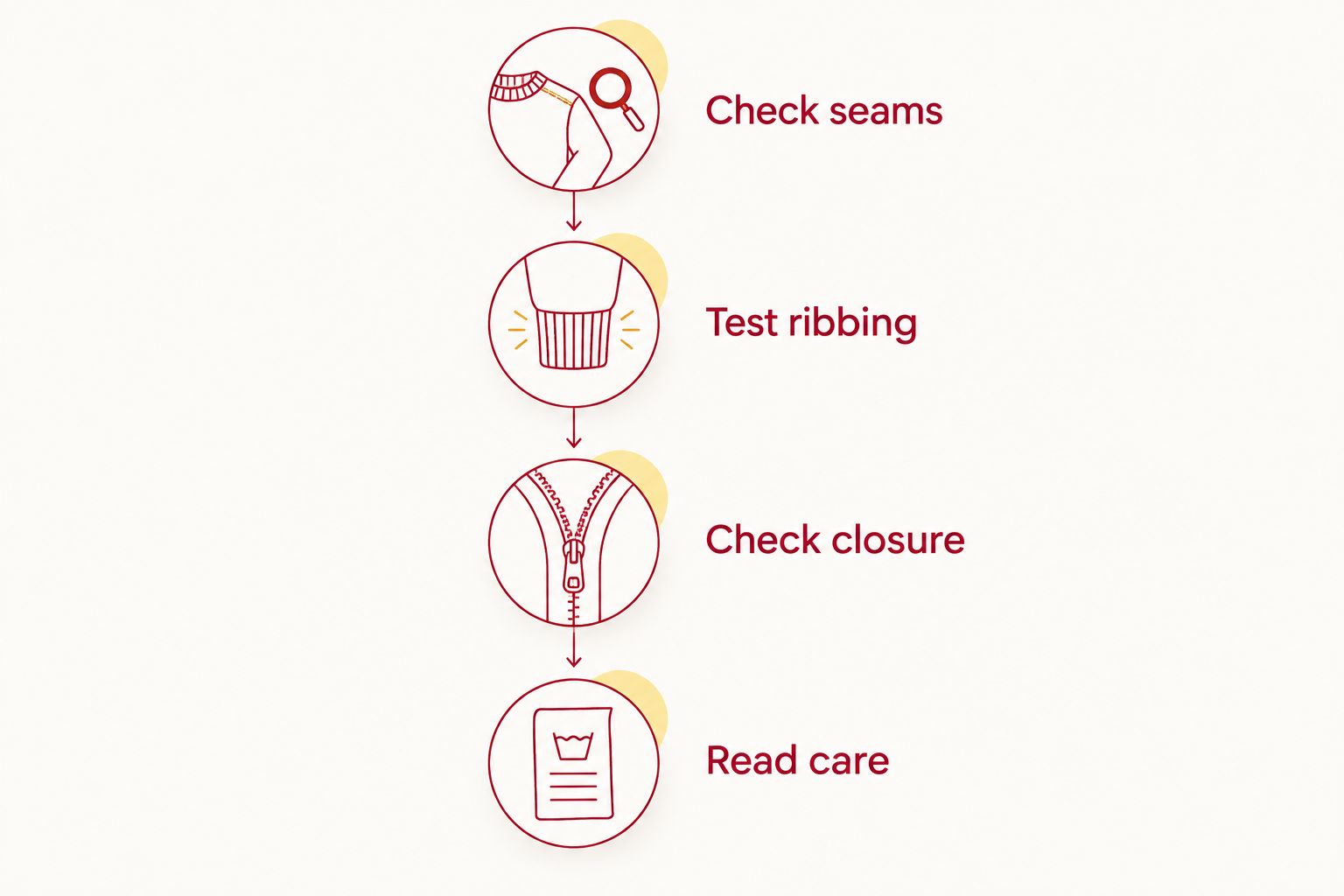
Do not stretch a garment aggressively to prove it is strong. The goal is to identify obvious construction problems, not create damage. If an online listing leaves a critical question unanswered, ask about that specific detail before choosing.
Which heavyweight hoodie should you choose?
Choose a reinforced pullover as your default. It suits the reader who wants an uncomplicated outer layer and does not need a front opening. Choose French terry for its looped interior, brushed fleece for its soft interior, or a zip-up for adjustable layering.
For Redletters heavyweight hoodie shopping, keep design preference and durability evidence separate. Faith-based artwork can decide which piece feels like you; construction should decide whether you buy it.
Your 2026 winner is the hoodie that passes inspection and fits your care routine. Not the one with the loudest weight claim.
FAQ
What's the best heavyweight hoodie construction for durability?
A reinforced pullover is the default construction choice when you want fewer closure components to maintain. Seam quality, rib recovery, and fabric condition still determine whether the actual garment deserves the purchase.
Does a higher GSM mean a hoodie lasts longer?
No. GSM measures fabric mass per square metre, not seam strength, abrasion resistance, or lifespan. Compare construction and care requirements alongside fabric weight.
Is French terry more durable than brushed fleece?
The fabric names alone do not establish a durability winner. French terry has an unbrushed looped interior, while brushed fleece has a raised interior surface; inspect the actual knit and construction.
Are pullover hoodies better than zip-ups?
Pullovers are better for component simplicity, while zip-ups are better for adjustable layering. A well-constructed zip-up is a better purchase than a pullover with weak seams or unstable ribbing.
What should I check first on a heavyweight hoodie?
Check the underarm seams and pocket attachments first. Then inspect the hood joins, cuffs, hem, and any zipper for obvious construction problems.
Is Redletters a good option for faith-based hoodies?
Redletters is a faith-based streetwear option for shoppers who want expressive hoodies and zip-ups. Choose the design you like, then assess the specific garment's construction and care instructions.
How do I wash a heavyweight hoodie without damaging it?
Follow the care label on the specific hoodie. Fabric, decoration, and closures can require different treatment, so a generic washing rule should not replace the garment's instructions.
What should I prioritize when buying a heavyweight hoodie in 2026?
Prioritize secure seams, stable ribbing, suitable fabric, and care instructions you will follow. Use weight as supporting information rather than proof of durability.
One last thing
A hoodie can lose its fresh surface appearance while its seams remain intact. It can also look clean while a pocket attachment starts to fail. Check appearance and structure separately.
Before your next wash, look at the pocket corners and underarms. Address a loose stitch before continued wear turns a small problem into a larger repair. That habit is more useful than chasing an unsupported lifetime claim.